
Key Takeaways
- Fit matters more than features. Five variables—volume, labor pain, site access, workflow maturity, and utilization—determine whether a Mulch Mule will deliver ROI for your specific operation.
- There’s a clear volume threshold. Operations moving 500+ cubic yards of bulk material per season are the sweet spot. Below 200 yards, the math doesn’t work.
- Labor savings drive the fastest payback. With nearly 80% of landscaping companies struggling to fill positions and labor costs projected to rise 20% by 2029, the Mulch Mule’s ability to cut labor costs by up to 30% addresses the industry’s most pressing challenge.
- It’s not for every operation. Low volume, tight site access, bagged-material work, or lack of a proper tow vehicle are hard disqualifiers. Knowing when to pass is just as valuable as knowing when to buy.
- Year-round utilization changes the ROI equation. The Mulch Mule handles mulch, soil, gravel, sand, compost, and leaves. Companies that use it across all four seasons—especially with the optional Billy Goat leaf vacuum—see the strongest returns.
- A hybrid fleet is often the smartest answer. The most efficient landscape operations pair the Mulch Mule with complementary equipment like skid steers, dump trailers, and wheelbarrows—each handling what it does best.
The Mulch Mule is one of the most efficient material-handling trailers on the market. With a 15-cubic-yard aluminum hopper, a reversible live floor system, curbside discharge conveyor, and optional wireless remote control, it can fill a wheelbarrow in 3–6 seconds and fully discharge its hopper in as little as 45 seconds. It handles mulch, soil, gravel, compost, sand, leaves, and more—making it a genuine year-round asset for landscape professionals.
But here’s the thing: it’s not for everyone. And that’s not a knock against the equipment. It’s a reality check on how equipment purchases should work. This guide is designed to help you figure out whether a Mulch Mule fits your operation today, whether you need to grow into it, or whether a different solution makes more sense.
The Real Question: Is It the Right Tool for Your Operation?
Every landscaping company is different. What works for a five-crew commercial operation will not automatically work for a two-person residential team. In an industry valued at over $188 billion in 2025 with more than 692,000 businesses (according to NALP industry statistics), the range of operations is enormous. Before you look at features, look at fit.
Why “Fit” Matters More Than Features
It’s easy to get excited about a piece of equipment after watching a demo video or hearing a peer talk about their results. The Mulch Mule’s live floor system and rapid discharge are impressive, and for the right operation, they’re transformational. But equipment ROI isn’t about what a tool can do in isolation—it’s about what it can do inside your specific business.
Fit means asking: does this solve a problem I actually have, at a scale that justifies the investment? If you’re not moving enough material, don’t have the job sites to support it, or can’t keep it running consistently, even the best piece of equipment becomes a liability sitting in your yard.
The 5 Variables That Determine Equipment ROI
Before evaluating any piece of equipment—including the Mulch Mule—run it through these five variables:
- Volume: How many cubic yards of bulk material are you moving per week? Per season? Equipment like the Mulch Mule is purpose-built for high-volume bulk installs. If your volume is low, you won’t recoup the investment.
- Labor Pain: Are you hemorrhaging hours on manual loading and wheelbarrow runs? Are you struggling with turnover because the work is physically brutal? According to the National Association of Landscape Professionals (NALP), nearly 80% of landscaping companies struggle to fill open positions, and labor costs are projected to rise roughly 20% by the end of 2029. The Mulch Mule reduces labor costs by up to 30% and reduces the physical toll on your crew, which directly impacts retention.
- Access: Can you get a 24-foot, 8-foot-wide trailer to the job site? Can you stage it curbside? If your jobs are mostly tight residential lots with narrow driveways and no street parking, you’ll face a logistical bottleneck.
- Workflow: Is your operation structured enough to fully integrate a specialized trailer? Do you have routing, job scheduling, and crew coordination in place to maximize utilization?
- Utilization: Will the Mulch Mule be used consistently throughout the year? Between mulch installs, leaf cleanup, soil delivery, and gravel handling, year-round use is achievable, but you need a plan for it.
Quick Self-Assessment: Are You a “Yes,” “No,” or “Not Yet”?
Use the checklists below for an honest gut check. This isn’t about selling yourself on something. It’s about making a smart capital decision.
Mulch Mule Makes Sense If You Check These Boxes
- You install 500+ cubic yards of bulk material per season (or plan to)
- Labor costs on material handling are eating into margins
- You regularly complete jobs involving 5+ cubic yards per site
- Your job sites allow curbside staging for a 24-foot trailer
- You have (or are purchasing) a tow vehicle rated for the payload
- You’re dealing with crew turnover driven by physical labor demands
- You want a year-round tool, not just a spring/summer mulching solution
- You value clean, precise material placement over blowing or dumping
If you checked five or more of those boxes, the Mulch Mule is likely a strong fit.
Red Flags—Pause Before You Buy
- Your annual bulk material volume is under 200 cubic yards
- Most of your work is bagged material or small residential deliveries
- You lack a suitable tow vehicle and don’t plan to acquire one
- Your job sites are consistently inaccessible to a full-size trailer
- You don’t have a realistic plan to keep the unit utilized across seasons
If several of these apply, it doesn’t mean a Mulch Mule will never make sense for you. It means now probably isn’t the time.
“Not Yet” Scenarios: Steps to Make It Work in the Future
A “not yet” is not a “no.” It’s a growth plan. Here are common situations where operators aren’t quite ready, and what to do about it:
- Volume is growing but not there yet: Focus on booking more bulk install jobs. Track your cubic yards per season and set a threshold (500+ yards is a common tipping point).
- No tow vehicle: Factor the tow vehicle into your capital plan. A properly rated truck is a prerequisite, not an afterthought.
- Workflow isn’t structured: Invest in crew management systems and routing software before adding specialized equipment. The Mulch Mule amplifies an organized operation—it doesn’t fix a disorganized one.
- Seasonal only: Explore how to use the Mulch Mule for leaf cleanup with the optional Billy Goat leaf vacuum attachment, soil and gravel delivery in off-seasons, and general material hauling. As Gregg from C&S Landscape shared with Landscape Management: “Having a piece of equipment that’s sitting there with a vac system on it, and you know it’s good to go and you know how much it can hold, is amazing.” Year-round utilization changes the ROI math entirely.
When a Mulch Mule Clearly Makes Sense (Best-Fit Scenarios)
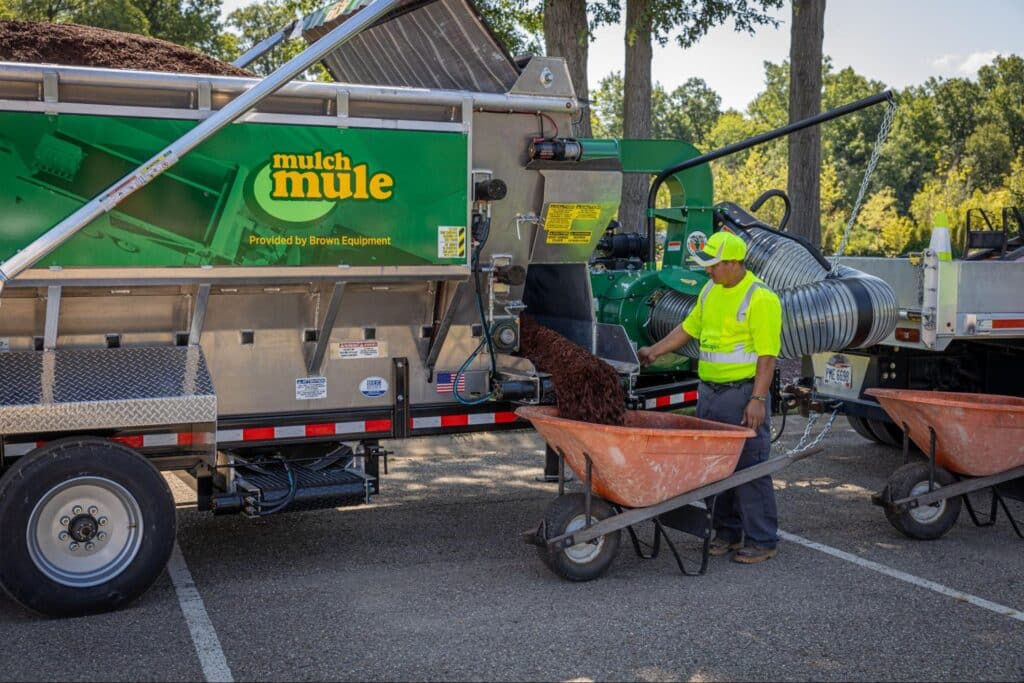
Here’s where it gets specific. These are the operational profiles where a Mulch Mule delivers the strongest return.
Frequent Bulk Installs and Labor Bottlenecks
If your crews are spending half their day loading wheelbarrows by hand, you’re burning labor dollars on the lowest-value activity on the job site. The Mulch Mule’s curbside discharge fills a wheelbarrow in 3–6 seconds—unassisted. On a typical 10-yard mulch job, that translates to finishing material placement in a fraction of the time compared to manual methods. When you multiply that across hundreds of jobs per season, the labor savings alone can pay for the unit within a year.
As Eberhardt Landscaping in Norton, OH puts it: “The Mulch Mule has significantly increased our efficiency, allowing us to complete jobs faster and with less labor. It’s been a game-changer for our operations.” Watch their full testimonial.
Easier Unloading, Less Physical Strain
The Mulch Mule’s live floor system lets you roll material out at a controlled flow rate using a wireless remote — no tipping, no avalanche of mulch to deal with. Your crew unloads what they need, where they need it, without the back-breaking work of shoveling out a traditional dump trailer. That means less fatigue over the course of a long day and more yards covered with the same crew. For operations that serve commercial properties, HOAs, or upscale residential clients, that efficiency matters to both your reputation and your bottom line. As one operator noted: “It’s really helped us out in a lot of beneficial ways to where we can do 100–150 yards of mulch with a five-six man crew a day.”
Year-Round Material Handling Needs
The Mulch Mule isn’t just for mulch. It’s engineered to handle gravel, soil, bark, leaves, compost, sand, and more. Equipped with the optional 37HP Billy Goat leaf vacuum, it becomes a powerhouse during fall cleanups. Its reversible live floor also allows forward and reverse loading and unloading of skidded materials, making it useful for construction material staging, event setup, and municipal projects. Companies that leverage the Mulch Mule across all four seasons see the highest utilization rates and the fastest ROI.
Gage Brothers Property Management summed it up: “Investing in the Mulch Mule was one of the best decisions we’ve made. It has streamlined our material handling process, saving us time and money on every project.”
Throughput Without Extra Headcount
Hiring and retaining landscape labor is one of the industry’s biggest pain points. The 2024 State of the Landscape Labor Market report found that 25% of landscaping companies have an average retention rate of 69% or lower, and only 37% even have an employee recruiting and retention strategy in place. The Mulch Mule allows a smaller crew to match or exceed the output of a larger one—without the manual strain that drives turnover. As Brown Equipment Company notes, operators can double their productivity with a third of the manpower. That’s not a sales pitch. It’s basic math: fewer labor hours per job, more jobs completed per day, and a crew that actually wants to come back tomorrow.
One Mulch Mule owner put it simply: “We’re seeing double the productivity with the same amount of guys… and the morale has been phenomenal this spring compared to prior years.” Another operator shared: “We bought a Mulch Mule… we have two of them now that have been very helpful for us, really speed up the productivity for us. With the labor industry and how bad the shortages are it’s really helped us out in a lot of beneficial ways.”
When a Mulch Mule Does NOT Make Sense (Hard Disqualifiers)
Just as important as knowing when to invest is knowing when to hold off. The Bureau of Labor Statistics reports that landscaping and groundskeeping had 102 fatal occupational injuries in 2023 alone, and musculoskeletal disorders account for roughly 30% of all private-sector cases requiring days away from work. Those numbers underscore why the right equipment matters—but only if the investment pencils out for your specific operation. Here are the scenarios where a Mulch Mule is not the right call.
Too Low Volume or Poor ROI
If you’re handling fewer than 200 cubic yards of bulk material per year, the math doesn’t work. The Mulch Mule is a significant capital investment, and to justify it, you need consistent volume. A handful of small residential jobs per month won’t generate enough savings to offset the cost of ownership. This doesn’t mean the equipment isn’t valuable—it means your operation hasn’t reached the scale where it makes financial sense.
Site Access Constraints
The Mulch Mule trailer measures approximately 24 feet long and 8 feet wide. If the majority of your work involves tight urban lots, narrow driveways, gated communities with restricted access, or sites with no curbside staging, you’ll constantly be working around the trailer rather than with it. A tool that can’t get to the job site is a tool you’re paying for and not using.
Mostly Bagged or Small Deliveries
The Mulch Mule is designed for bulk material handling. If your operation primarily involves delivering bagged mulch, topsoil, or stone to residential clients, a standard pickup truck or utility trailer is a more practical and cost-effective solution. The Mulch Mule’s 15-cubic-yard hopper and live floor system are engineered for high-volume loose material, not palletized bags.
Towing, Storage, or Maintenance Limitations
You need a properly rated tow vehicle (typically a Class 4 or 5 truck), adequate yard space to store a 24-foot trailer, and a basic maintenance routine to keep it running. If your fleet is made up of half-ton pickups, your shop is a shared parking lot, or you don’t have the operational discipline for routine upkeep, adding the Mulch Mule will create more friction than it solves. The Mulch Mule is designed for minimal maintenance—simple upkeep, no specialty tools, and no costly tarp replacements—but you still need to commit to the basics.
Misaligned Expectations
The Mulch Mule is not a skid steer replacement. It won’t grade a site, move boulders, or dig trenches. It’s a purpose-built material transport and distribution system. If you’re expecting a Swiss Army knife, you’ll be disappointed. But if you understand what it does—haul and discharge bulk materials faster than any manual process—it delivers exactly that, with speed and reliability.
“If Not a Mulch Mule, Then What?” (Alternatives Overview)
If a Mulch Mule isn’t the right fit right now, here’s a quick look at alternatives and where each one excels—and falls short.
Dump Trailer
A dump trailer is a solid option for transporting bulk material to a job site. It’s more affordable than the Mulch Mule and can handle a variety of materials. However, it dumps everything in a pile, which means your crew still has to manually load wheelbarrows and distribute material by hand. There’s no controlled discharge and no labor savings at the point of installation. It moves material from Point A to Point B, but it doesn’t solve the labor bottleneck.
Utility Trailer
A flatbed or utility trailer works for smaller-scale operations, especially those doing mixed work. You can haul equipment, bagged material, and light loads of loose material. But for bulk installs, it’s limited in capacity and offers no mechanical discharge. It’s a starting point, not a scaling solution.
Mulch Blower
Mulch blowers are fast for large open areas—think highway medians, commercial campuses, and large-scale municipal projects. But they’re noisy, generate significant dust, and can damage delicate plants and flower beds. They also require specialized operators and higher maintenance. The Mulch Mule takes a different approach: instead of blowing material directly, it discharges material curbside through a controlled chute, filling wheelbarrows in 3–6 seconds so crews can place material by hand with precision and zero plant damage. There’s no dust, no noise disruption, and no specialized operator required—just fast, clean material handling that keeps your crew moving.
Skid Steer + Attachments
A skid steer with a bucket is versatile for loading material but isn’t designed for precise distribution. It’s great for site prep, grading, and moving material within a yard, but on the actual job site—especially residential or commercial properties—it’s often too heavy, too wide, and too destructive to turf. It complements a Mulch Mule in a fleet rather than replacing it.
Carts and Wheelbarrows
Manual carts and wheelbarrows are the baseline, and every landscape company owns them. They’re inexpensive, require no tow vehicle, and go anywhere. But they’re also the most labor-intensive, the slowest, and the primary source of crew fatigue and injury. They’ll always have a role on the job site, but if you’re relying on them as your primary material-handling method at scale, you’re leaving money and efficiency on the table.
Decision Framework: A Simple Scoring Rubric
If you want to move beyond gut feel and make a data-driven decision, use this five-factor scoring rubric. Rate each category from 1 (poor fit) to 5 (strong fit) based on your current operation.
Volume and Frequency Score
How many cubic yards of bulk material does your operation move per season, and how frequently? Score a 5 if you’re consistently above 500 yards per season with multiple bulk jobs per week. Score a 1 if bulk installs are rare or low-volume. This is the most heavily weighted factor because without sufficient volume, the savings won’t materialize.
Labor and Safety Exposure Score
How many crew hours are consumed by manual material handling? Are you experiencing injuries, workers’ comp claims, or turnover tied to physical strain? A score of 5 means labor pain is a constant headache. A score of 1 means your current process handles material comfortably with existing crew and methods.
Access and Staging Score
What percentage of your job sites can accommodate a 24-foot trailer curbside? Score a 5 if most of your jobs have open street access, wide driveways, or staging areas. Score a 1 if tight lots, gated communities, or restricted access are the norm.
Workflow Maturity Score
How well does your operation handle scheduling, routing, and crew coordination? The Mulch Mule works best in organized, process-driven companies. Score a 5 if you use crew management software and have standardized processes. Score a 1 if your daily workflow is largely reactive and unstructured.
Utilization Plan Score
Do you have a plan to use the Mulch Mule across seasons—mulch in spring, soil and gravel in summer, leaf cleanup in fall, and aggregate handling in winter? Score a 5 if you’ve mapped out year-round applications. Score a 1 if it would sit idle for half the year.
Interpreting Your Score:
- 20–25: Strong fit. Move forward with confidence. As one owner said: “It’s a profit maker! It really takes your business to the next level—profitability, efficiency, and our guys are just much, much happier.”
- 14–19: Conditional fit. You may benefit from the Mulch Mule, but address weak areas first (access, workflow, or utilization planning).
- 8–13: Not yet. Focus on building volume, improving operations, and evaluating again in 6–12 months.
- 5–7: Not a fit right now. Consider alternatives listed above.
| Factor | Your Score (1–5) | Notes |
| Volume & Frequency | 500+ yards/season = 5 | |
| Labor & Safety Exposure | High turnover/injuries = 5 | |
| Access & Staging | Open curbside access = 5 | |
| Workflow Maturity | Structured processes = 5 | |
| Utilization Plan | Year-round use planned = 5 | |
| TOTAL | / 25 | 20–25 = Strong Fit |
Hybrid Fleet: Often the Right Answer
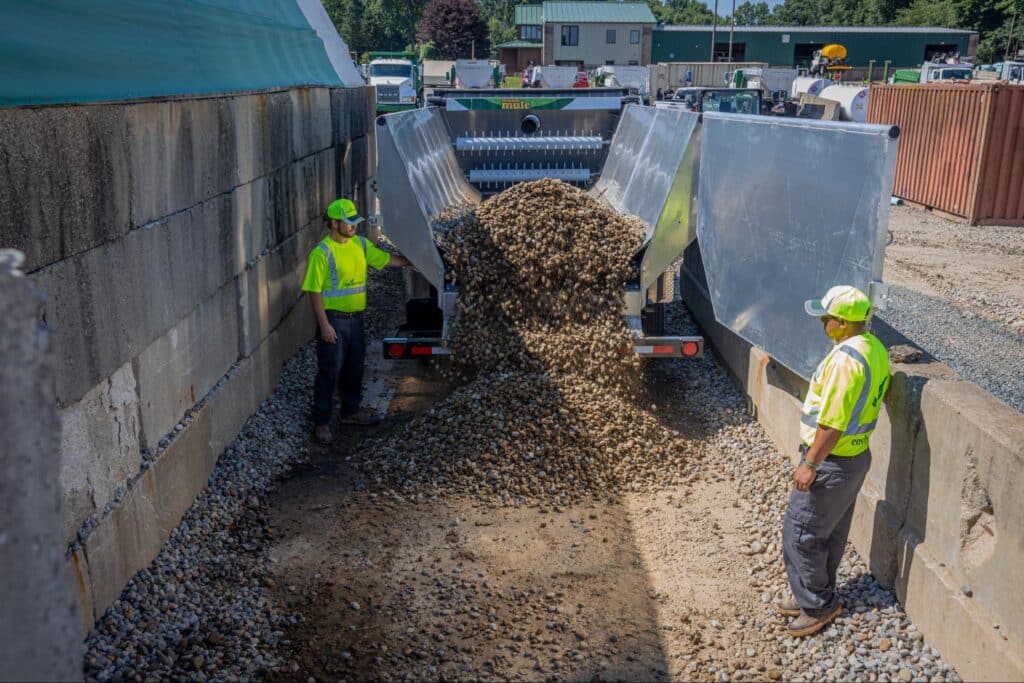
Here’s a truth that doesn’t get said enough: you probably don’t need to choose just one solution. The most efficient landscape operations run a hybrid fleet where each piece of equipment handles what it does best.
Example Setups
Mid-size commercial operation (3–5 crews):
- Mulch Mule as the primary material transport and distribution unit for bulk installs
- Skid steer for site prep, grading, and loading material into the Mulch Mule at the yard
- Utility trailer for hauling equipment, pavers, and miscellaneous materials
- Wheelbarrows for final placement in areas the Mulch Mule can’t reach directly
Growing residential operation (1–2 crews):
- Dump trailer for general-purpose hauling and smaller bulk jobs
- Mulch Mule added once volume crosses 500+ yards/season
- Wheelbarrows and carts as the last-mile distribution tools on every job
High-volume mulch and material supplier:
- Multiple Mulch Mules running dedicated routes for bulk delivery and installation
- Billy Goat leaf vacuum attachment deployed on one or more units for fall cleanup season
- Skid steers at the supply yard for loading operations
Standardizing Operations for ROI
A hybrid fleet only works if your operations are standardized. That means consistent processes for material ordering, job scheduling, crew assignment, and equipment deployment. The companies that get the highest ROI from their Mulch Mule are the ones that treat it like a core part of their workflow—not an occasional add-on. They optimize their landscaping operations around the equipment, not the other way around.
If you’re planning for commercial properties or scaling your residential operation, standardization is the multiplier that turns a good equipment investment into a great one. The Mulch Mule is built to last 20+ years with minimal maintenance, so the question isn’t whether it’ll hold up. It’s whether your operation is ready to get the most out of it. As one satisfied owner shared: “We were roughly a month and a half ahead of schedule with having the Mulch Mule… we’re able to get more work done, sell more work, more revenue.”
Next Steps
You now have a clear framework for evaluating whether a Mulch Mule fits your operation. Here’s how to move forward:
- Run the scoring rubric above: Be honest. If you score 20+, you’re ready.
- Schedule a live demo: Find a Mulch Mule ambassador near you and see the equipment perform in real-world conditions on your job site.
- Request a quote: Visit the Mulch Mule quote page to get pricing tailored to your setup, including optional attachments and upgrades like the contractor package, extension conveyor, and wireless remote.
- Explore financing: Mulch Mule offers flexible financing options to help fit the investment into your cash flow.
- Keep learning: Browse the Mulch Mule blog for more operational insights and watch video demonstrations to see the equipment in action across different job types and seasons. You can also watch Landscape Management’s feature walkthrough with Brown Equipment Company for an independent, in-depth look at the machine’s capabilities.
As Leafstone Landscapes and countless other operators have discovered, the right equipment at the right time doesn’t just save money. It changes how your company operates, how your crew feels at the end of the day, and how fast your business can grow. Leafstone, Trace’s Lawn Care, Minard’s Landscape and Design, and many others have shared their stories on the Mulch Mule testimonials page. If a Mulch Mule fits, it’s one of the smartest investments you can make. If it doesn’t fit yet, now you know exactly what to work toward.