In the fast-paced world of landscaping, every minute on a jobsite has a direct impact on your bottom line. Whether you manage a small crew or oversee multiple teams, understanding how quickly and efficiently materials are moved and applied is essential. One useful way to gauge productivity is by using a throughput metric for landscapers—often expressed in yards per hour for landscaping operations. Tracking throughput can help you identify process phases that might be causing delays, optimize workflows, and potentially reduce labor costs, all of which contribute to improved profitability. Modern landscaping operations are increasingly focused on these measurable improvements.
Why Throughput (Yards/Hour) is the Key to Maximizing Profitability
Throughput is not just about moving material; it’s about transforming the efficient use of time into tangible results. By focusing on yards per hour, you can capture a snapshot of jobsite efficiency that goes beyond traditional productivity metrics like total hours worked or overall material volume moved.
Throughput vs. Traditional Productivity Metrics
Standard productivity measures such as total hours worked or the cumulative volume of material transported can sometimes mask underlying performance differences. For example, while two crews might move the same volume of mulch, the crew that completes the work faster demonstrates superior efficiency. Focusing on yards per hour highlights these discrepancies and offers actionable insights into where improvements can be made.
The Hidden Costs of Low Throughput
When throughput is low, projects tend to extend beyond their planned timelines, which increases labor expenses and may delay job completion. Extended project durations can boost operational costs and may even lead to customer dissatisfaction and missed opportunities. Addressing inefficiencies that hinder throughput can help complete jobs more quickly, reduce expenses, and enhance your team’s reputation.
Understanding the Factors That Impact Throughput
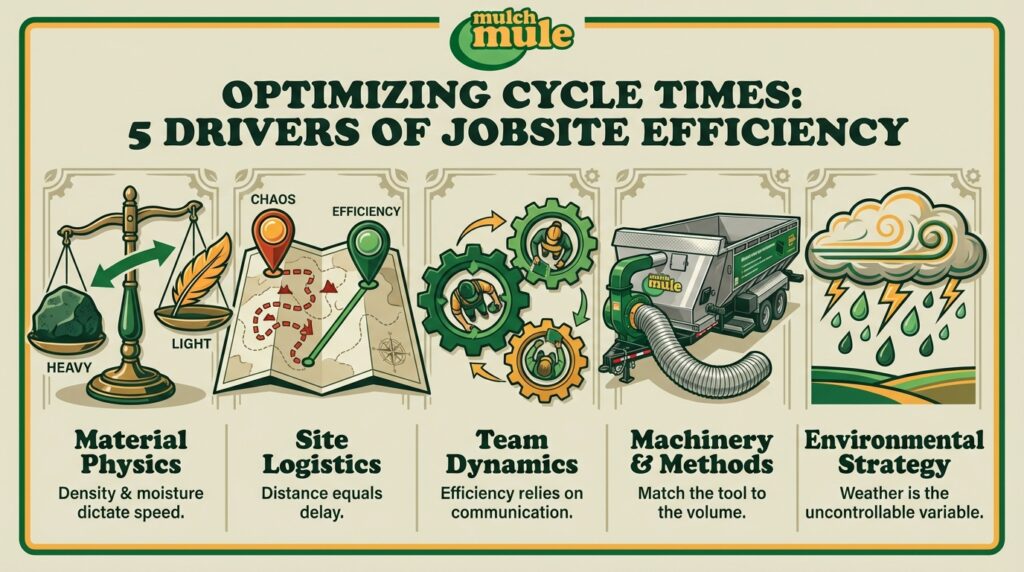
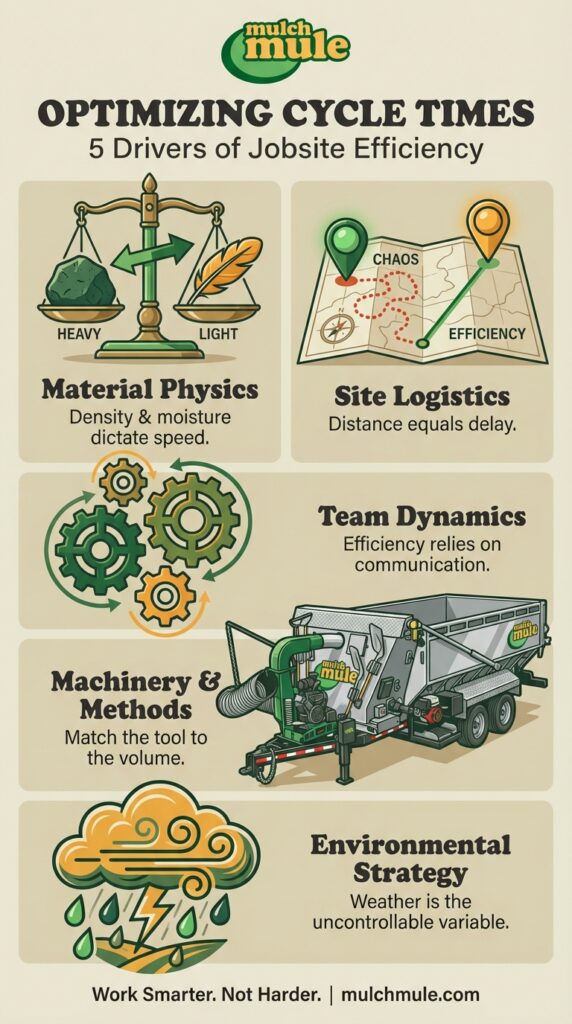
Achieving optimal throughput depends on several key factors. Each one influences cycle time and overall efficiency, and understanding them is crucial for targeted improvements.
Material Characteristics and Properties
Different materials behave in unique ways. Lightweight mulch may be easier to load and spread, while denser materials like soil or stone require more effort. Additionally, moisture content can affect behavior—wet materials might clump, while dry ones can scatter unpredictably. Recognizing these physical differences helps in setting realistic benchmarks for various material types. For more detailed insights, see Smart Landscaping Planning for Commercial Properties Success.
Jobsite Layout and Terrain
The physical layout of your jobsite can significantly affect travel times. Shorter distances between material stockpiles and the work area reduce cycle times. A flat, unobstructed layout is generally more efficient than one with tight spaces or uneven terrain.
Crew Coordination and Skill
Efficiency is closely tied to how well the team operates together. Clear communication, defined roles, and well-practiced workflows all reduce wasted time. When every crew member understands their responsibility—from loading to material placement—the overall process runs more smoothly and quickly.
Tools and Equipment
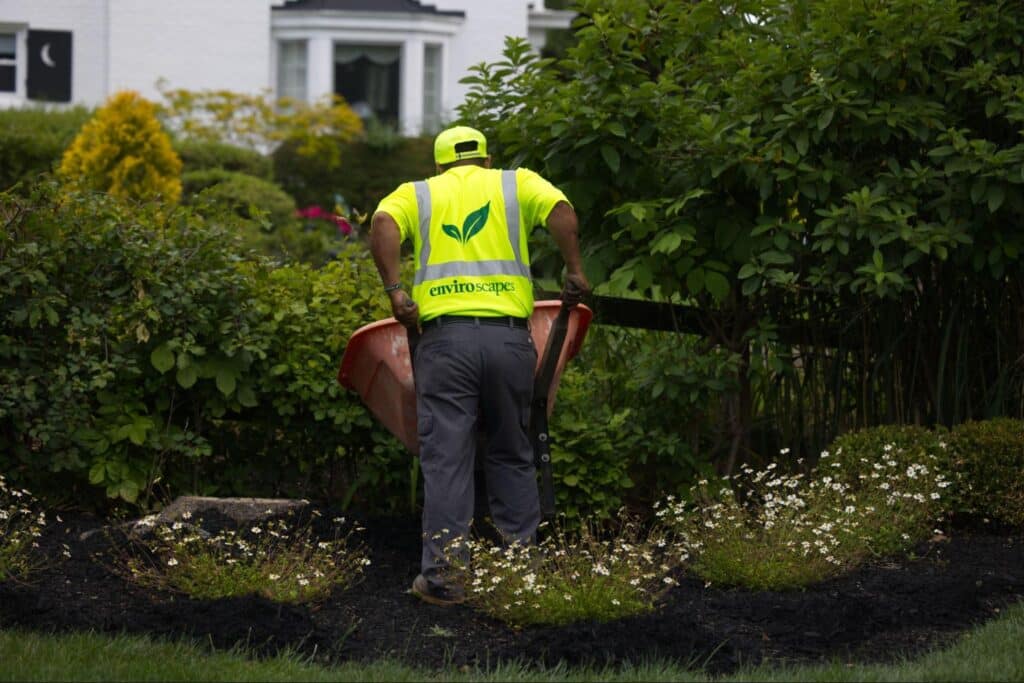
The equipment you use greatly impacts throughput. While manual methods such as wheelbarrows and shovels may suffice for smaller jobs, larger projects benefit from machinery designed for efficiency. Industry estimates suggest that manual labor typically yields between 3–6 yards per hour, skid steers can reach approximately 6–15 yards per hour, and mulch blowers often maintain rates of 15 or more yards per hour. Live floor trailers, renowned for their automated handling capabilities, are highly valued for streamlining material movement.
Weather and Environmental Conditions
Extreme temperatures, high winds, or heavy rain can significantly slow work progress. While weather is beyond control, proactive planning—such as adjusting daily workflows—can help minimize disruptions and maintain more consistent throughput rates.
The Throughput Formula: A Practical Tool for Real Jobsites
Even if you’re not a math expert, measuring your crew’s efficiency doesn’t have to be complicated. With a simple formula, you can calculate how many yards of material your team moves per hour.
Breaking Down the Process into Cycles
Every work cycle on a jobsite involves several key phases:
- Load Time: The time taken to load material onto the transport.
- Travel Time: The time required to move from the material stockpile to the work area.
- Placement Time: The period during which the material is spread or applied.
- Idle Time: Any pauses or waiting periods during the cycle.
Calculating Yards per Hour
The basic formula is:
Throughput (yards/hour) = Effective Yards Moved ÷ Total Cycle Time (in hours)
For example, if a crew moves 0.5 cubic yards per cycle and completes 10 cycles in an hour:
Effective Yards Moved = 0.5 yards × 10 cycles = 5 yards
Throughput = 5 yards ÷ 1 hour = 5 yards/hour
This baseline figure can be compared with established benchmarks to identify which phases might benefit from further optimization.
Measuring Your Crew’s Production Rate (Field-Tested Method)
Accurate throughput measurement depends on consistent data collection.
Essential Tools for Data Collection
Simple tools like a smartphone timer, tally sheets, or a notebook can record cycle durations, ensuring that data monitoring doesn’t disrupt crew workflow.
Step-by-Step Data Collection Process
- Time individual cycles: Start timing at the beginning of the loading phase and stop once material placement is complete.
- Record each phase separately: Log times for loading, travel, placement, and any idle intervals.
- Perform multiple measurements: Track data over 5 to 10 cycles to calculate an accurate average.
- Calculate material volume and total cycle time: Use these figures to compute the average effective yards moved per cycle.
For example, if each cycle moves 0.75 cubic yards and the crew completes eight cycles in an hour:
Effective Yards Moved = 0.75 × 8 = 6 yards
Throughput = 6 yards per hour
This data helps pinpoint where delays occur, enabling you to focus on eliminating specific inefficiencies.
Benchmarks: What’s Realistic and Why It Varies
Throughput rates vary based on methodology and jobsite conditions. Here are some general guidelines derived from industry observations:
- Manual Labor (Wheelbarrows, Shovels): Approximately 4 yards per hour for a crew of 5 workers
- Skid Steers: 10 yards per hour with 3 workers
- Mulch Blowers: Approximately 15 yards per hour with 5 workers
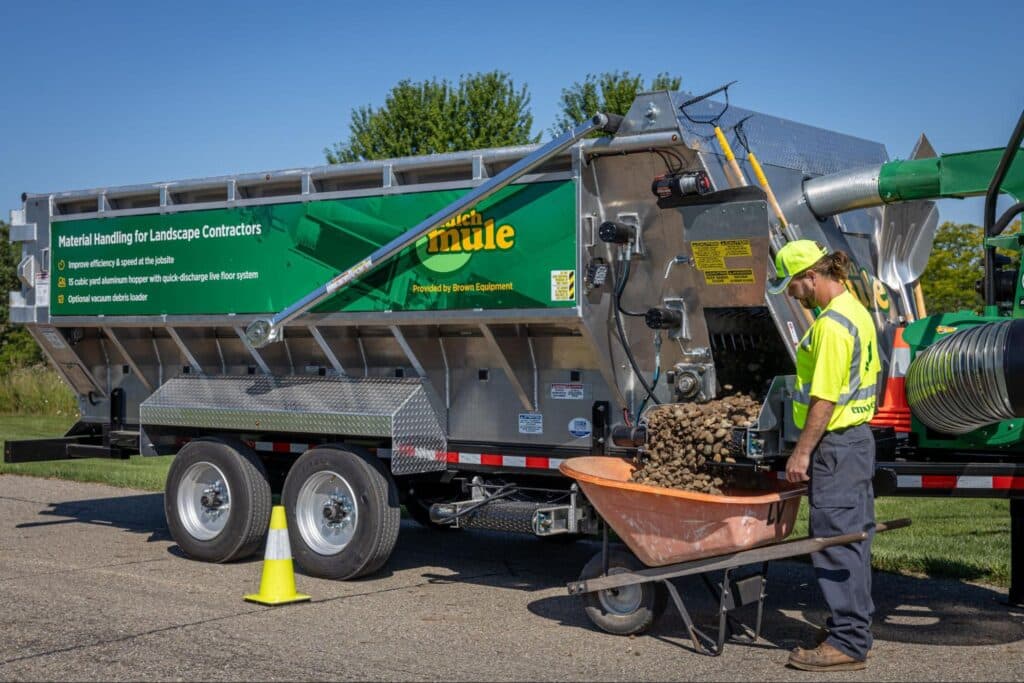
- Mulch Mule Trailer: Approximately 15 yards per hour with 5 workers
Keep in mind that these figures can vary with material type, terrain, and the overall efficiency of your specific operation.
Find Your Bottleneck: Pinpointing Efficiency Obstacles
When throughput falls short of expectations, identifying bottlenecks is essential. By isolating phases that consume the most time, you can prioritize improvements that yield immediate operational benefits.
Common Bottlenecks on the Jobsite
- Loading delays: Materials may not be staged efficiently or equipment might be misconfigured.
- Extended travel time: Longer distances or challenging terrain can increase cycle time.
- Placement inefficiencies: Ambiguous instructions or improper equipment use can lead to repeated adjustments.
- Crew coordination lapses: Miscommunication or idle time can further slow the process.
Addressing these issues—through improved material staging or adjusted workflows—can significantly enhance throughput.
Improving Throughput Without New Equipment
Efficiency gains aren’t solely dependent on new machinery. Often, refining current processes can lead to considerable improvements.
- Optimize Material Staging: Position materials as close to the work area as possible to reduce travel time. Organized staging can substantially lower cycle times.
- Streamline Task Sequencing: Effective task sequencing minimizes downtime. Arrange work so that as soon as one phase ends, the next begins seamlessly, ensuring a continuous workflow.
- Define Clear Crew Roles: Clear responsibilities reduce confusion. When each crew member is focused on a specific task—whether loading, transporting, or placing—the overall process becomes more efficient.
When Equipment Changes the Equation
While process improvements are valuable, sometimes upgrading the equipment can amplify efficiency gains. Advanced machinery can reduce repetitive tasks, accelerate material handling, and lessen physical demands on the crew.
For instance, the Mulch Mule trailer is noted for its quick-discharge system, capable of emptying a large hopper rapidly. Additionally, advanced equipment solutions like live floor trailers use hydraulically powered systems for automated, controlled, and safe material movement. Such innovations not only streamline operations but also support workplace safety by minimizing manual handling risks.
From Throughput to ROI: Maximizing Efficiency and Profitability
Increasing your yards-per-hour isn’t just about faster work—it directly impacts profitability. A higher throughput rate translates to more jobs completed in less time, reduced labor costs, and ultimately, better profit margins.
Translating Throughput into Financial Gains
Even small reductions in cycle time can lead to significant cost savings. Shaving minutes off every cycle means lower labor expenses across multiple projects, ultimately enhancing your overall ROI.
Equipment Investment and Long-Term Savings
Investing in specialized equipment like live floor trailers can yield high returns. By reducing manual labor and minimizing delays, these systems contribute to both immediate operational efficiency and long-term growth while helping to lower insurance and workers’ compensation costs.
Continuous Improvement: Use Data and Crew Feedback to Raise Yards/Hour
Track 3 Numbers Weekly
Once you’ve measured throughput on a few jobs, the fastest gains usually come from tracking a small set of repeatable numbers. Keep it simple—consistency matters more than complexity. Track these three metrics each week (or per mulch job type):
- Yards per hour (YPH): Your top-line throughput number. Formula: total yards installed ÷ total crew hours (or machine hours—just be consistent).
- Minutes per cycle: The average time it takes to complete one full loop (load, travel, place, return). This points directly to where time is leaking.
- % idle time: Any time waiting, repositioning, rework, unclear instructions, or “nothing is moving.” If idle time is high, you can often improve throughput without new equipment.
Time 5–10 cycles with a phone timer, average them, and jot down the biggest delay each cycle (e.g., “loader waiting,” “travel path blocked,” “re-spreading”).
Run a 10-Minute End-of-Job Debrief
A short debrief turns your measurements into real improvement. Do it while the job is fresh—right after cleanup or back at the truck.
Keep it to 10 minutes and ask:
- What slowed us down today? (Pick the #1 bottleneck—don’t list ten things.)
- Where did we lose time in the cycle? (Loading, travel, placement, or idle.)
- What’s one change we’ll try on the next job? (Only one—make it testable.)
- What should stay the same? (Lock in what worked.)
Write the one change down and check whether YPH improves on the next similar job.
Standardize the Best Workflow (Staging, Roles, Load Method)
Once you find a setup that consistently improves yards/hour, turn it into a repeatable standard so results don’t depend on which foreman is leading that day.
Standardize these three items:
- Staging map (simple is fine): Mark where material is staged, where equipment will park, the crew’s travel path, and the placement sequence. A quick sketch on a clipboard works.
- Role assignments: Define who is loading, who is transporting/positioning, who is placing/spreading, and who is doing detail work—before the first cycle starts.
- Load method: Decide how loads will be sized and dispatched (full vs partial loads, where the first drop goes, how you’ll avoid over-delivery to one area that creates rework).
Fewer decisions during the job = less idle time = better throughput.
Tech to Consider
Technology helps most when it’s used to reduce friction—not add it. Start with tools your crew will actually use every job.
Level 1 (recommended starting point):
- Smartphone timer for cycle timing
- Simple tally sheet (paper) or Google Sheet to log:
- job type/material
- yards installed
- average minutes/cycle
- idle-time notes
- yards/hour result
Level 2 (when you’re ready):
- A shared form (Google Form) that feeds your spreadsheet automatically
- Basic job costing integration (so you can compare YPH to labor cost per yard)
Level 3 (optional, only if it fits your operation):
- Telematics, sensors, or more advanced apps to track run time, location, and utilization
- These can be powerful—but only after you’ve built the habit of measuring and acting on the basics.
If you can’t picture your foreman using it on a busy day, don’t deploy it yet. The best system is the one that gets used consistently.
FAQ: Throughput (Yards/Hour) for Landscaping Crews
What is throughput in landscaping?
Throughput is how quickly your crew can move and apply material through the jobsite process. For mulch and soil installs, it’s commonly measured as yards per hour (YPH).
How do you calculate yards per hour (YPH)?
The simplest method is: Yards/Hour = Total Yards Installed ÷ Total Time (hours).
You can also calculate it by cycles: estimate yards per cycle, time how long an average cycle takes, then convert that into cycles per hour.
What counts as a “cycle” when tracking throughput?
A cycle is one repeatable loop of work: loading material, traveling to the placement area, placing/spreading, then returning or resetting for the next load. If you define the cycle the same way each time, your numbers will be comparable across jobs.
What is a good yards-per-hour benchmark for mulch installation?
Benchmarks depend on site layout, material conditions, and the method you use. As a broad reference, manual wheelbarrow work is often much lower than mechanized handling, and systems designed for continuous discharge tend to be higher. The best benchmark is your own baseline from 2–3 typical jobs, then you improve from there.
What affects throughput the most on real jobsites?
In most cases, throughput is determined less by how hard people work and more by how much time is lost to long travel paths, poor staging, congestion, rework, and waiting. Tight access, slopes, tender turf, and wet or heavy material can also slow cycles down.
How can I measure throughput without slowing the crew down?
Pick a normal job, then time 5–10 cycles with a phone timer while someone observes. Record the average cycle time and make a quick note about what caused the biggest delay. That small sample is usually enough to reveal the bottleneck.
Put Throughput to Work: Turn Yards/Hour Into Profit
Optimizing your yards-per-hour is a strategic initiative that turns every minute into measurable profit. By thoroughly understanding each phase—from loading to idle time—you can identify inefficiencies, refine operations, and drive profitability. Whether through process improvements or through the adoption of advanced equipment like live floor trailers, every step toward streamlining your workflow contributes to lower costs, faster project completion, and increased client satisfaction.
Begin tracking your yards-per-hour with these practical strategies and harness the power of streamlined throughput for operational success. Discover innovative solutions and expert advice at Mulch Mule.