
Getting mulch installation pricing right is crucial to achieving profitability in the landscaping business. While material costs are often straightforward to calculate, labor is frequently underestimated—resulting in slimmer profit margins. This guide teaches you how to price mulch installation jobs using real production data, clear gross margin targets, and an effective change order process to prevent scope creep.
A data-driven pricing approach ensures that mulch jobs do more than keep your crew busy—they generate reliable income.
Why Mulch Jobs “Feel Busy” but Lose Money
Mulch installs keep crews moving—but they can still bleed profit when estimates are based on gut feel instead of real production data. Small inefficiencies across the day stack up fast, turning “busy” into lower-than-expected margins.
Mulch projects keep crews active through loading, hauling, spreading, and cleanup. However, if estimates rely on gut feelings rather than real data, hidden inefficiencies drive up labor costs. Factors like unclear task definitions, extra preparation work, and inefficient unloading quickly add up, leaving you with lower-than-expected profits. A strategic pricing process must address these issues upfront to ensure every project contributes positively to your bottom line.
The Hidden Margin Killers
The profit leaks usually come from the work that doesn’t show up on the bid: travel time, unloading delays, bed prep (edging, debris removal, reshaping), and full cleanup. Add in rework—touch-ups, thin spots, washouts, or return trips—and labor hours climb without you charging for them.
The Most Common Pricing Mistake
A frequent error in pricing mulch installations is underestimating labor. Many landscapers calculate materials correctly but rely on arbitrary guesses for labor hours, ignoring tasks such as bed edging, debris removal, and site adjustments. Labor costs must include wages, payroll taxes, benefits, and other indirect expenses. Basing estimates solely on this cost control guide or intuitive assumptions puts your business at risk of underbidding jobs and eroding profit margins.
Understanding Unit Economics for Accurate Pricing

Accurate pricing begins with understanding what you’re selling. Mulch installation is not just about spreading material—it’s about transforming a landscape with clear, defined tasks. Your pricing should cover both the volume of material (measured in cubic yards or square feet at a specific depth) and the labor required to prepare, spread, and clean up.
Common Mulch Pricing Models
- Price Per Cubic Yard Installed: This model charges a fixed rate for each cubic yard of mulch, covering materials, labor, and overhead. Its simplicity makes it easy for clients to understand.
- Price Per Square Foot at a Specified Depth: Ideal for large projects, this model bases pricing on the area covered and a defined mulch depth.
- Time and Materials (T&M): For projects with uncertain scopes, clients pay for actual labor hours and materials. This reduces the risk of underestimating costs but may be less appealing for clients seeking a fixed price.
Defining the Job Scope
Before starting a project, clearly outline:
- Mulch depth requirements
- Edging and weed control tasks
- Debris cleanup responsibilities
- Site-specific challenges (e.g., narrow access, steep slopes)
- Protection measures for plants and hardscapes
A well-defined scope prevents misunderstandings and helps you price jobs that account for all necessary work.
Implementing Production Rates for Accurate Pricing
Production rates represent how much work your crew can complete under typical conditions. They are an essential part of making estimates more precise and consistent.
What are Production Rates?
Production rates measure tasks completed per hour (e.g., cubic yards or square feet per hour). They factor in real-world delays such as setup time and minor adjustments. Relying on these rates instead of guesses helps you accurately predict labor needs. To learn more, review these production rate tips.
Key Rate Metrics
- Bed Preparation Rate: Time for tasks like edging and weed clearing measured in sq ft/hr.
- Mulch Spread Rate: Time (yd/hr or sq ft/hr) to spread mulch evenly.
- Loading/Unloading and Movement Rate: Time (yd/hr including handling) taken to transfer mulch from the supplier or truck to the work site.
Collecting Production Data
Gather data from several projects:
- Record total area or volume
- Note crew size and skill levels
- Track time spent on each task, separating on-site work from travel and delays
- Adjust for site-specific challenges
Averaging these over five to ten projects provides reliable production rates that form the basis for your estimates.
Profitability, efficiency, simplicity, and employee morale are just some of the benefits of using Mulch Mule for mulch, soil, gravel and then vacuuming leaves in the fall. Andrew and Anthony Gage are happy customers of two Mulch Mules! Click on the video below to hear what they have to say about their experience with the Mulch Mule.
Step-by-Step Estimating Workflow
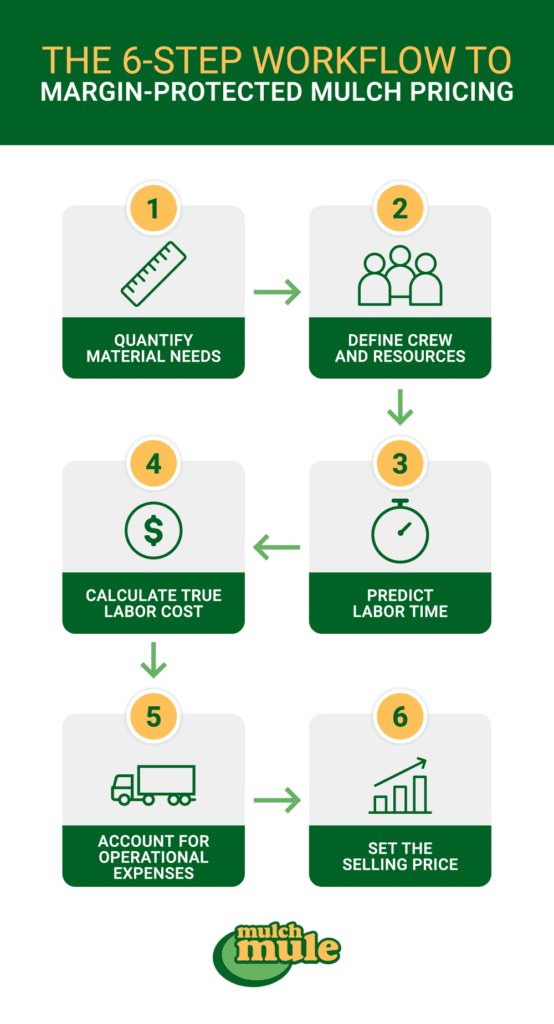
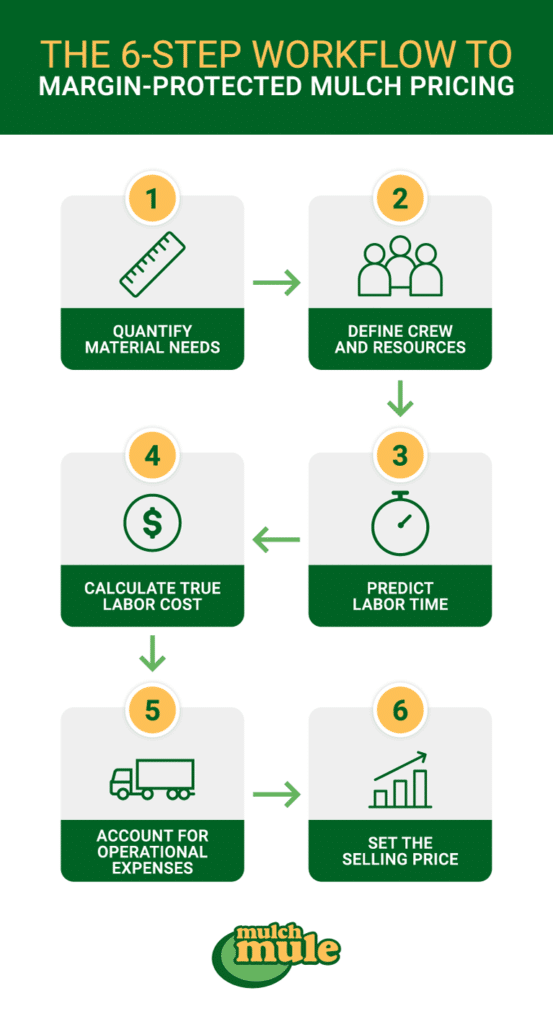
Developing accurate estimates involves a systematic process. Follow these steps to build a pricing strategy that reduces guesswork:
Step 1: Measure the Area and Convert to Volume
Determine the total square footage of the area to be mulched. Convert this measurement to cubic yards based on the desired mulch depth (e.g., 3 inches = 0.093 cubic yards per square foot) and add a 5–10% buffer for variations.
Step 2: Match Crew Size to Job Needs
Assign the appropriate team based on the project’s size and complexity. For smaller jobs, a two-person crew might suffice; larger projects may require three or more workers.
Step 3: Calculate Labor Hours Using Production Rates
Use your established production rates to estimate the total labor hours required. For instance, if your team spreads mulch at 0.5 cubic yards per hour and the job requires 15 cubic yards, you’d need 30 labor hours.
Step 4: Determine Full Labor Costs
Multiply the total labor hours by your fully burdened labor rate (which includes wages, taxes, and benefits). This step provides a true estimate of labor expenses.
Step 5: Factor in Equipment, Overhead, and Delivery
Include costs for equipment usage, fuel, insurance, and other overhead expenses. Consider any delivery or material staging fees to ensure no costs are overlooked. You may also opt for Mulch Mule attachments designed to boost efficiency.
Step 6: Apply a Gross Margin Target
Decide on a gross margin target (for example, 40%) and price the job so that your total costs (labor, materials, overhead) represent no more than 60% of the final quote. This step preserves your profitability.
Adjusting Margin Targets for Job-Specific Challenges
Even with a set margin target, unique job conditions may require price adjustments. Consider increasing the quote when:
- Site Access is Difficult: Extra time for navigating obstacles like narrow gates or steep slopes.
- Cleanup and Detail Demands are High: High-visibility or premium properties may require more meticulous work.
- Additional Labor is Needed: Complex projects that involve intricate bed layouts or extra preparation work.
For smaller jobs, implementing a minimum job or mobilization fee ensures that even brief projects remain profitable.
Stopping Scope Creep with an Effective Change Order Process
Scope creep occurs when clients request additional work without adjusting the project price. To prevent this, establish a robust change order process:
- Identify the Change: Document any new requests or unexpected tasks immediately.
- Price the Addition: Use your production rates to calculate the additional cost.
- Communicate and Secure Approval: Clearly explain the cost impact to the client and get written approval before proceeding.
- Schedule the Additional Work: Integrate the change seamlessly into the project timeline.
- Invoice Promptly: Include all extra costs in the updated final invoice to ensure they are covered.
Using pre-built pricing for common add-ons, such as extra edging or debris clearing, further streamlines the process. A clear contract outlining scope boundaries from the start also helps minimize disputes and protects profit margins.
Actionable Strategies for Improving Labor Cost Management
To build long-term profitability, consider these practical tips:
- Track Production Data: Regularly monitor how long your crew takes for each task to refine estimates.
- Separate Travel Time: Distinguish between on-site work and travel time to identify areas for potential cost reduction.
- Standardize Job Scopes: Use a consistent scope template for all projects so clients know exactly what is included.
- Enforce Change Orders: Require formal approval for any additional work beyond the initial agreement.
- Invest in Efficiency: Equipment like the Mulch Mule trailer—featuring a live floor system—can drastically reduce manual labor.
With powerful solutions at your disposal, you can more than double your pace on projects, maintain year-round utilization for various applications, and ultimately enhance profitability.

Turning Efficiency Into Higher Profit (Not Just Lower Effort)
Efficiency isn’t just about making the day easier—it changes your cost per yard. When you reduce travel, unloading, bed prep, cleanup, and rework, you cut labor hours per job. That lets you either bid more competitively or keep more profit on fixed-price installs.
When Faster Production Should Lower Price vs. Raise Margin
Lower price when a sharper number will win more work (competitive bids, high-volume routes, large projects where price drives the decision).
Raise margin when you’re already booking jobs, the schedule is tight, or site risk is high. On fixed-price work, finishing faster doesn’t reduce revenue—it increases profit.
How Automation and Better Material Handling Impacts Production Rates (and Bids)
Most margin loss comes from handling: staging, unloading bottlenecks, long pushes, and extra “touches” of material. Better material handling and automation reduce those minutes and make production rates more consistent.
When handling time drops, your costs drop—so fixed-price bids become easier to hit and more likely to exceed your margin target.
Next Step: Plug This Into Your Labor Cost Reduction & Profitability Playbook
Efficiency only becomes profit when you track it consistently. Use a simple weekly scorecard to turn real job data into better production rates, tighter estimates, and clearer decisions about where to raise prices, improve processes, or change scope.
- Production Rates: yards/hr (or sq ft/hr) for prep, handling/unloading, spreading, cleanup
- Labor Variance: estimated hours vs. actual hours (and why)
- Gross Margin by Job Type: mulch installs vs. other work, so you know what’s truly paying off
Price Mulch Jobs With Data, Then Protect the Margin
Mastering mulch installation pricing isn’t just about adding up costs—it’s about protecting margin with clear scope, real production rates, accurate labor estimates, and disciplined change orders. Pair that process with labor-saving tools like the Mulch Mule, and mulch jobs stop being “busy” and start being consistently profitable. Take control of your pricing strategy and make every install count.
Make your next mulch bid more predictable. Schedule a demonstration today to see how a Mulch Mule trailer improves material handling on every job.